The Founders
Benjamin Franklin
Checked against the sources. Not yet reviewed by a historian.
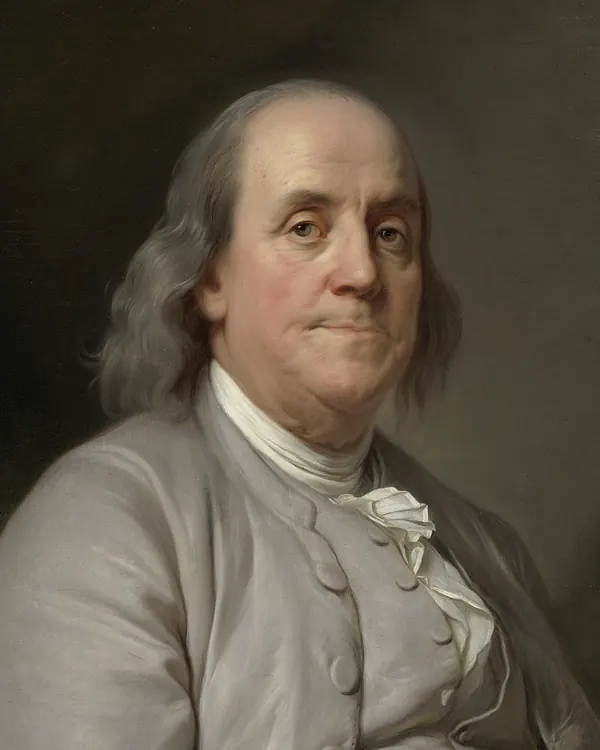
Benjamin Franklin was born in Boston in 1706 and died in Philadelphia in 1790. He was a printer, a writer, a scientist and an inventor. He served as a colonial agent in London, a member of Congress, the American minister to France and a delegate to the Convention of 1787.
Much of what he built, he built with his neighbors. In Philadelphia he helped found a lending library, a volunteer fire company, a hospital and an academy that became a university. He ran the colonies' mail, and he became the first Postmaster General under Congress. He showed that lightning is electricity, and he taught people how to guard a house against it.
He is honored for public work done in plain and useful ways. He refused a patent on his stove, because "as we enjoy great advantages from the inventions of others" we should serve others "freely and generously". When a mob murdered peaceful Conestoga Indians in 1763, he wrote against the killers and helped turn them back from Philadelphia. He signed the Declaration of Independence, the alliance with France, the peace with Britain and the Constitution. No other founder signed all four. In 1750 he told his mother, "I would rather have it said, He lived Usefully, than He died Rich".
His life had hard parts, and this account tells them where they happened. For decades he held enslaved people in his household, and his shop and newspaper helped others sell them. Late in life he turned against slavery, and his last public work was spent fighting it. He broke with his only son, who stayed loyal to the King, and the two were never reconciled. He spent thirteen of his wife's last seventeen years in England, and he was away when she died.
The whole life, chapter by chapter with its sources, is in Minuteman.
Open it in Minuteman. In the app it works with no signal.